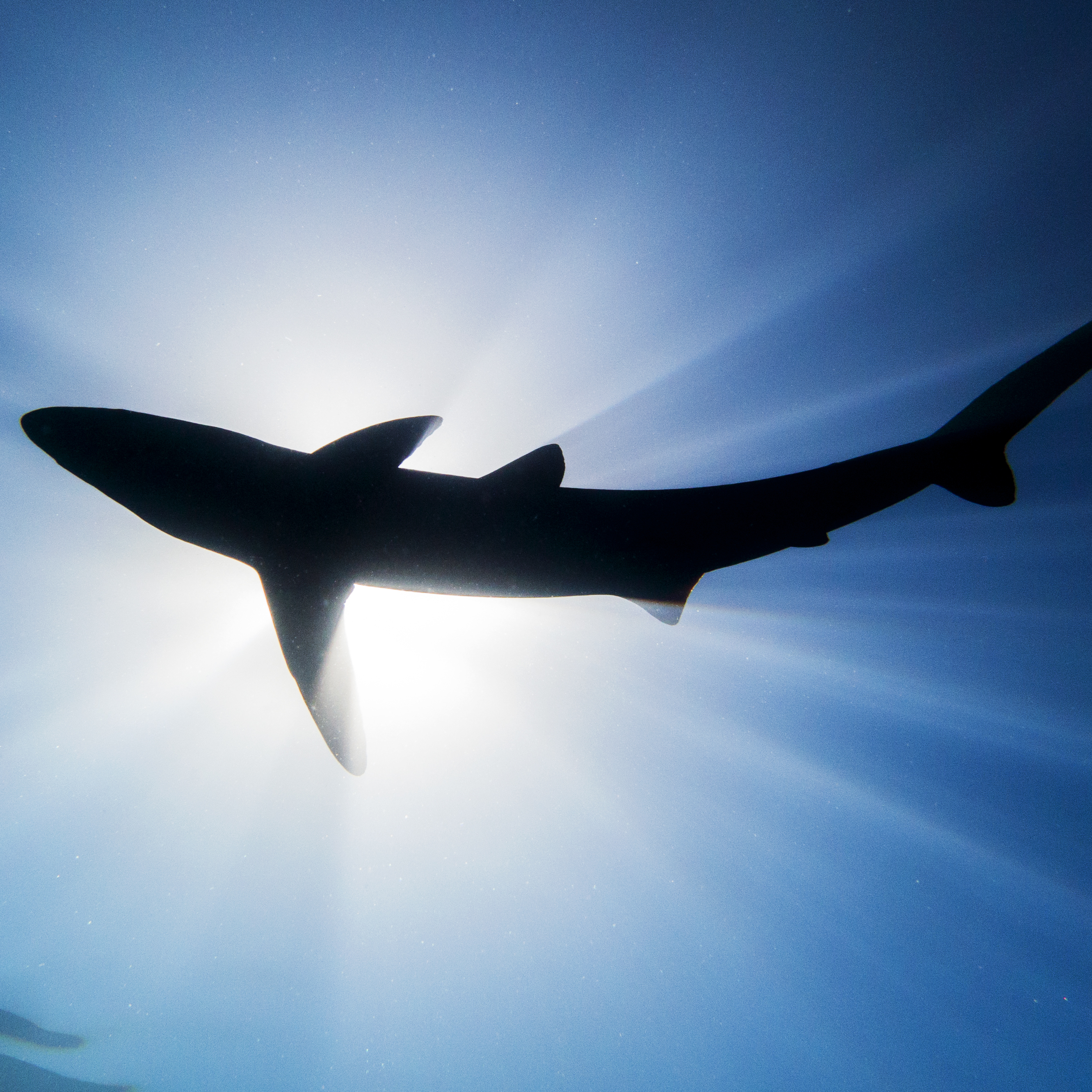
FISHING EFFORT MAPS AS SEEN FROM SATELLITE RADAR
source: Global Fishing Watch
Remote sensing allows the identification and quantification of some of the main anthropogenic (human) threats to elasmobranch species. In this context, it is available open-source data through the non-governmental organization Global Fishing Watch (GFW), where an artificial intelligence (AI) algorithm in conjunction with the latest radar technology coupled to the Sentinel satellite of the European Space Agency (ESA), creates a daily basis database with global coverage that allows the visualization of the position and the apparent fishing effort of vessels larger than 15 m.
This tools together allow for fishing vessels movement monitoring and quantifying the fishing effort in hours per square kilometer (h/km2), even when vessels turn off their Automatic Identification System (AIS), thus overcoming the long historic problem of ‘dark fishing’, a practice where fishing vessels turn off their AIS tracker to carry illegal activities, such as fishing within Marine Protected Areas (MPAs) in remote locations where monitoring and law enforcement are often nonexistent.
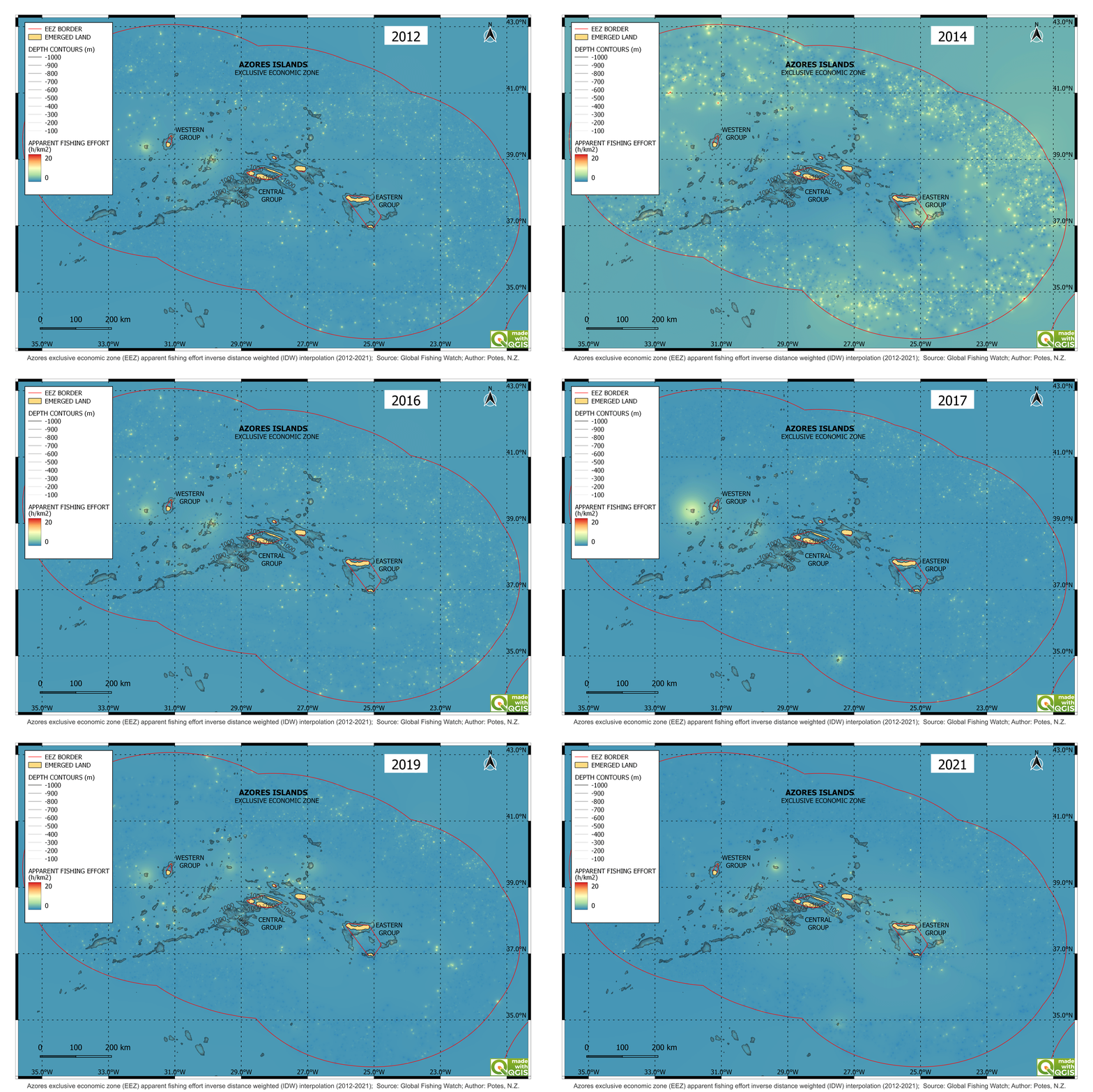
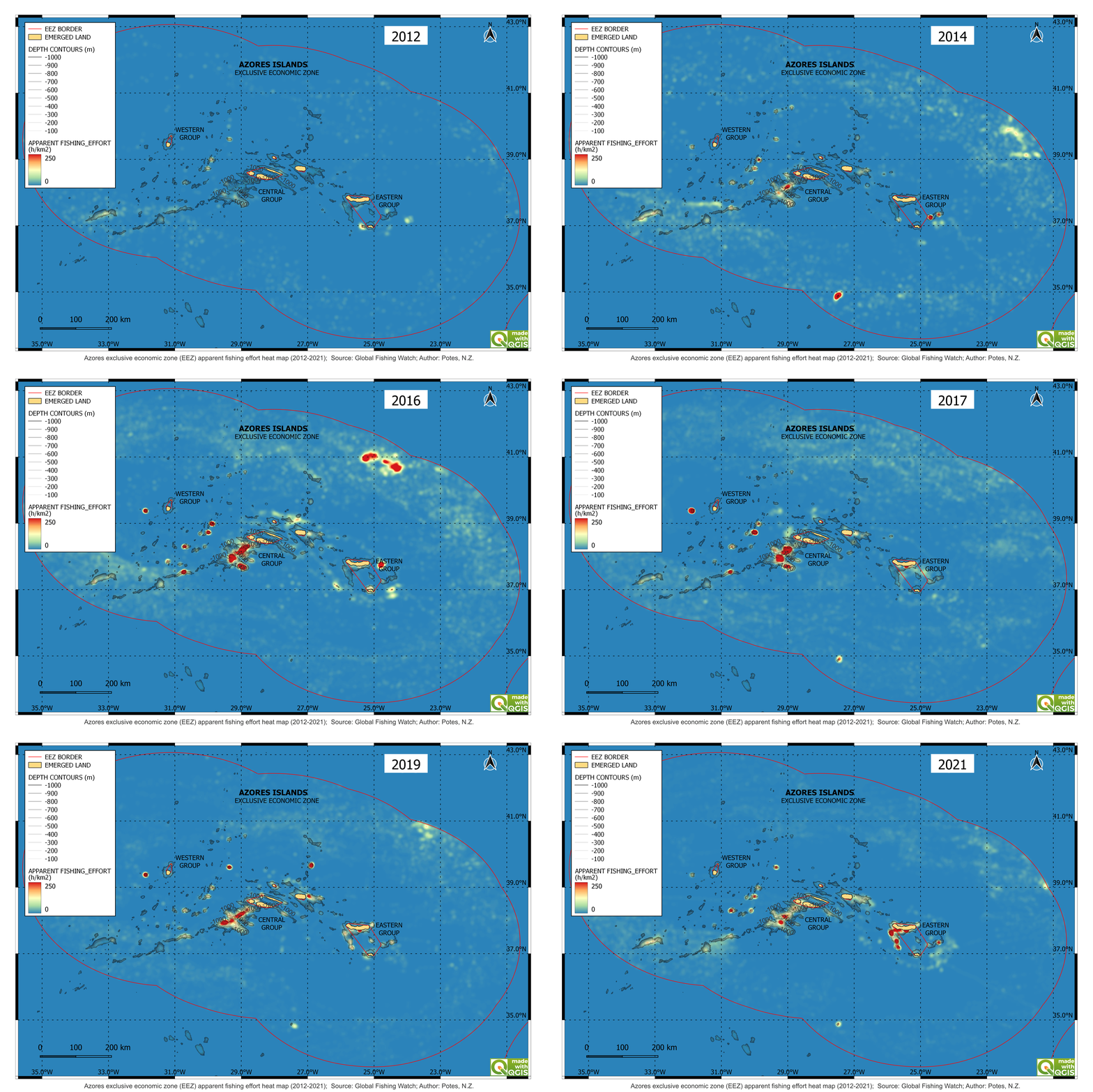
Fig. 1 & 2 : Seing the Azores exclusive economic zone (EEZ) as bottom layer, evidencing the seafloor and seamounts raising above -1000 m depth. you can see a 10 year span timelapse of the fishing effort from boats larger than 15m, derived from satellite radar. (data source: Global Fishing Watch). On the left side an inverse weight interpolation model, showing with lighter color where are the areas more prone to recieve fishing vessels considering the past fishing patterns. On the right side, the apparent fishing effort heat map which shows exactly where the fishing effort occours, having a heat colour gradient as reference for the intensity of the fishing activities per square kilometre (h/km2)
The main threats to the healthy maintenance of pelagic shark and ray populations in the Azorean EEZ are mainly of anthropogenic (human) origin, especially related to fishing mortality, happening wether as retaining cought species or by releasing/ discarding unwanted animals with carelless handling practices. Furthermore, after release survival rates are often rather low regarding the stress inflicted by fishing gear to hocked and retrieved animals.
In the Azores archipelago, most of the fishing effort occurring inside the EEZ (when excluding the traditional, small scale fisheries) that directly threatens shark and rays populations are performed with longline angling. This technique is composed of a surface ‘mother’ line attached to buoys on the surface, often measuring dozens of kilometers from where many thousands of baited hooks hang, mainly targeting swordfish and tunas. The longline apparel can either fish close to the surface (pelagic) or near the bottom (demersal), depending on the targeted species, but the basic structure, besides needed adaptations, remains the same. Longlines can occasionally set gear at depths exceeding 1000 m using relatively simple equipment, which make of the most important high seas habitats of the Azores susceptible to high intensity fishing pressure, the sea mounts.
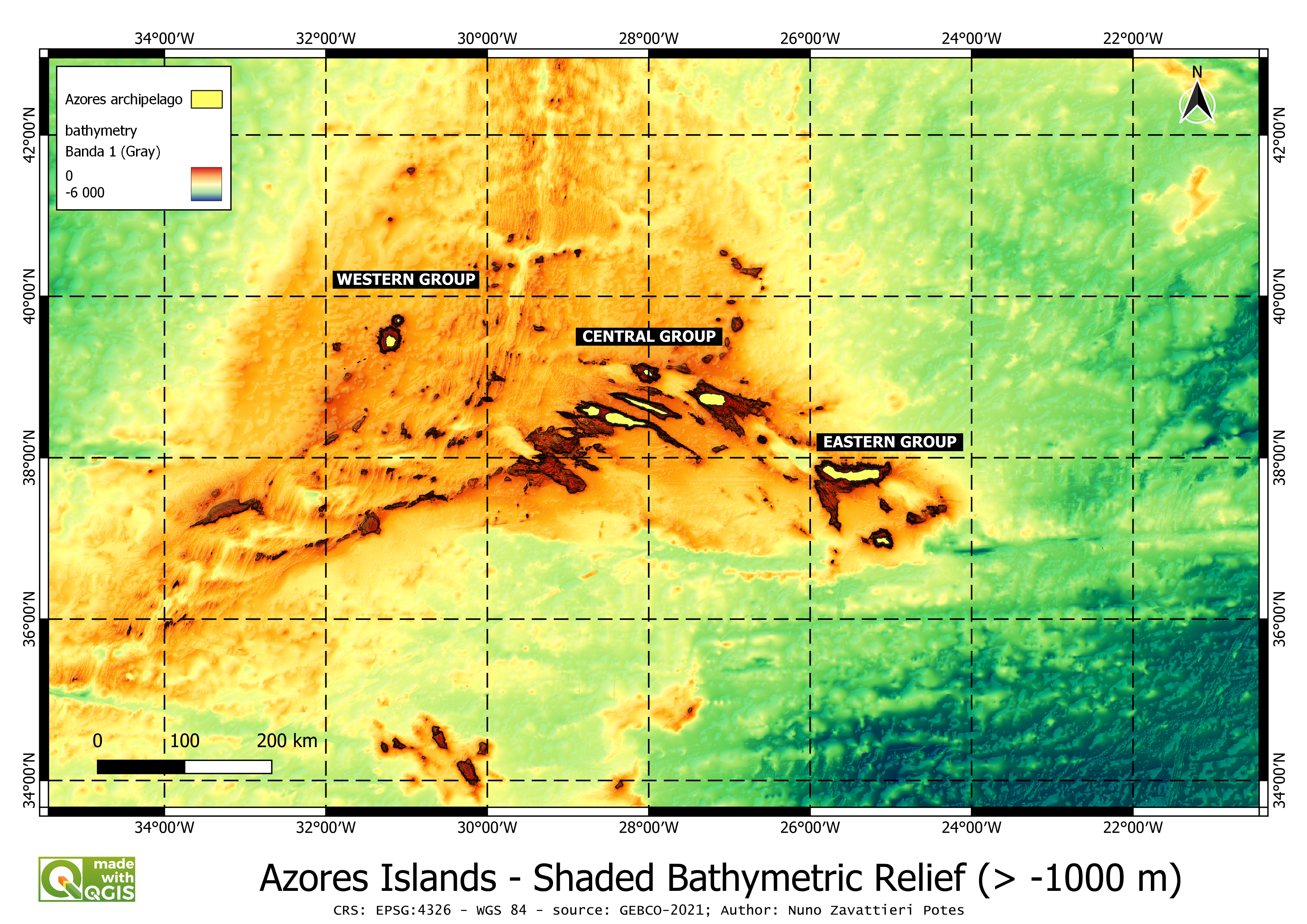
Fig. 3 : The Azores exclusive economic zone (EEZ) evidencing the bathymetric relief (‘seafloor topography’) and its seamounts raising above -1000 m depth. The conspicuos superstructures visible are the mid-atlantic ridge curved on the left half of the map and the Azores Plateau to the east of the ridge occupying the centreal part of the map. The darker red regions evidence the important seamounts (submerged mountains) rising from the ocean floor, sometimes, up to near the surface.
Longline are regarded as a very efficient fishing method, nonetheless, this effectiveness comes with a high price to pay for the ecosystem because of being a rather generalist technique and not species specific, capturing many unwanted species with little economic value, but sometimes with high ecological value, the so called ‘bycatch‘.
The bycatch species often have small survival rates, even when released. Within the most impacted species that are prone to being captured are dolphins, birds, sea turtles and sharks.
 CONSHARKVATION.ORG